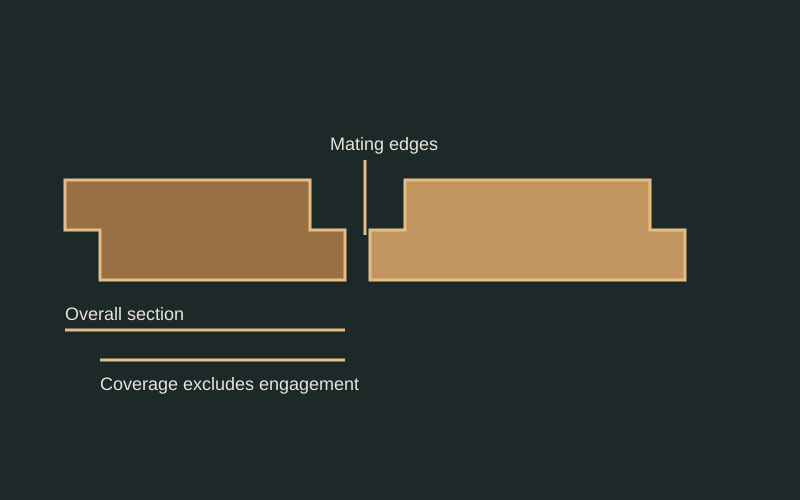
- The complete section includes its mating edge.
- Tongue engagement or lap changes the installed coverage.
- These family sections have no verified machining dimensions; obtain the supplied drawing.
Create a width vocabulary
Use separate fields for overall finished width, visible face width, and installed coverage. Define each field on a small cross-section instead of relying on the word width alone. NIST's nominal-versus-actual discussion is a useful reminder that a commercial size label is not itself a measurement. It does not supply the missing hardwood profile dimensions.
Find the repeating unit
Lay out several pieces in the intended arrangement and identify corresponding points on adjacent boards. The distance between repeated points describes the installed repeat for that arrangement. For an interlocking or overlapping profile, hidden geometry can make that repeat differ from overall width. Preserve the joint setting used during the review with the measurement.
Separate material from layout
Keep board coverage, boundary dimensions, and perimeter details in different parts of the takeoff. List openings and transitions explicitly. A narrower final course, a border, or a pattern change is a layout event, not a reason to quietly modify the board coverage value. This distinction makes later quantity revisions understandable to someone who did not prepare the first estimate.
Use units visibly
Write units beside every input and ensure the measured area and repeat use compatible units before calculating quantities. Keep raw dimensions in the worksheet even if a purchasing unit requires conversion. For linear quantities, include the planned cut lengths and available stock lengths so an apparent area match does not conceal unusable offcuts or missing long pieces.
Explain allowances
Show cutting, selection, and spare-material allowances separately from the geometric takeoff. Explain what each allowance covers and who approved it. Do not present a generic waste percentage as a universal property of hardwood. Irregular boundaries, appearance selection, and stock-length choices can change the practical order even when the installed area remains the same.
Practical checklist
- Define every width field with reference points.
- Record the joint arrangement used for coverage.
- Keep boundaries and allowances outside the coverage value.
- Audit units before releasing quantities.
Worked example
Hypothetical example: two quotes list the same commercial board width, but one profile overlaps more of the neighboring board. A revised comparison uses each documented installed repeat and makes the quantity difference visible before a purchase decision.
Limits of this guide
A trial layout supports a takeoff only for the reviewed arrangement. Moisture condition, product tolerances, and installation instructions still matter. This guide does not prescribe installation spacing, purchasing allowances, or guaranteed yield.
Continue the decision
Specify a square-edge board beyond its name
Read a tongue-and-groove section before ordering
Define shiplap overlap and the visible reveal
Profile explorer