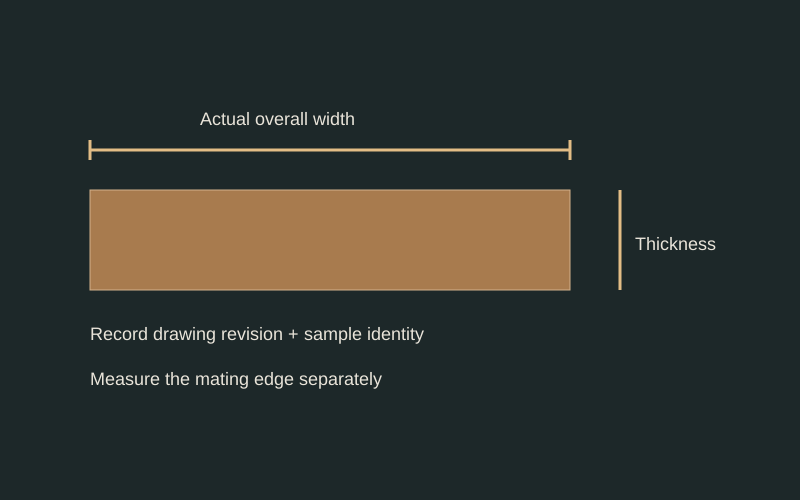
- The face alone does not identify the mating geometry.
- Record actual width and thickness separately from the nominal name.
- Replacement and submittal review also require edge detail, tolerances and a drawing revision.
State the decision requested
Begin with the location and application, followed by the exact approval being sought. Distinguish a dimensional profile review from finish approval or complete assembly acceptance. Identify the drawing revision and material product so a reviewer can tell whether a later sample belongs to the same proposal. Avoid presenting a collection of unlabeled catalog pages as a coordinated submittal.
Provide one authoritative section
Show the visible face, overall dimensions, edge features, feature positions, and any asymmetric back treatment. Use clear units and identify the source of tolerances. Put commercial naming in a separate description field. Where a dimension is unavailable, flag it as an open item rather than estimating it from the illustration and allowing that estimate to look authoritative.
Show the installed relationship
Include an adjacent-board sketch identifying coverage, joint appearance, and the applicable installation detail. Cross-reference the intended attachment system where the profile engages clips or another component. USDA treats fastening behavior as a joint-design issue; the submittal should therefore make the boundary between profile approval and connection approval visible rather than silently combining the two.
Identify samples and exceptions
Assign sample IDs, mark the exposed face, and explain whether the sample represents geometry, finish, or both. List deviations from the requested profile in a short comparison table. Include the proposed resolution and responsible reviewer for each deviation. A reviewer should not need to notice an altered groove location by comparing two small drawings at different scales.
Control release and receiving
After review, issue a clean record that incorporates the accepted changes and preserves unresolved holds. Link the purchase order to that revision. Provide a receiving checklist based on the approved features and retain a labeled reference sample. If a shipment differs, record the difference and obtain a disposition before installation makes the evidence difficult to inspect.
Practical checklist
- Define the scope of approval requested.
- Supply a dimensioned and oriented cross-section.
- List deviations and unresolved items explicitly.
- Link the release and receiving record to one revision.
Worked example
Hypothetical example: a finish sample is approved while the groove drawing remains under review. The release record identifies those separate statuses, preventing the appearance approval from being interpreted as permission to buy the entire clip-and-board assembly.
Limits of this guide
A complete-looking submittal is not engineering approval. The responsible project reviewers determine installation, structural, moisture, and code requirements. Generic references cannot certify a specific machined product or resolve missing manufacturer information.
Continue the decision
Measure a hardwood profile so another person can verify it
Keep face width and installed coverage separate
Check a grooved edge against its intended clip
Profile explorer