Text equivalent
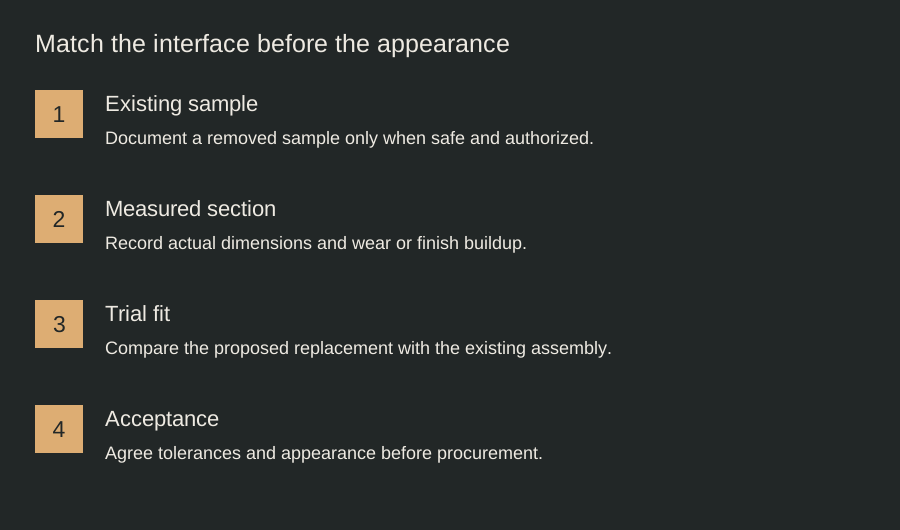
Existing sample
Document a removed sample only when safe and authorized.
Measured section
Record actual dimensions and wear or finish buildup.
Trial fit
Compare the proposed replacement with the existing assembly.
Acceptance
Agree tolerances and appearance before procurement.
Matching only the exposed face can leave incompatible tongue engagement, groove height or overall thickness.
Download diagram (SVG)Original educational diagram · Hardwood Profiles · September 14, 2026.
Review a replacement profile
Start by naming what must remain: neighboring boards, trim, supports and any mating components. A replacement can resemble the exposed face yet fail to engage the retained work. Treat appearance and interface as separate acceptance questions.
Document the existing condition
Where removal is safe and authorized, retain an identifiable sample and record its orientation. Photograph the face and section together. Note worn edges, damage and finish buildup so a measurement of the old piece is not silently treated as the original manufacturing dimension.
If the section cannot be inspected, describe what remains concealed. A face photograph does not establish the tongue, groove, lap or rear relief. Keep a proposed match provisional until the needed features can be established.
Compare features against the retained assembly
Review overall thickness, face alignment and the engagement features that matter to the specific joint. Distinguish an existing dimension from a proposed replacement dimension. Do not average them into a single “close enough” size or invent a tolerance to make the comparison pass.
A trial fit should use the actual proposed section and representative retained work where practical. Record which pieces were tried and what was observed. Fitting one loose sample does not resolve every field condition, attachment requirement or production variation.
Example: matching the face but missing the joint
In a fictional replacement request, the new board has the desired face width and color, but its tongue sits at a different height from the retained groove. The appearance match does not close that conflict. Return to the section comparison and resolve a compatible replacement or a revised repair detail before procurement. Do not conceal the mismatch by forcing engagement.
Agree the acceptance record before ordering
Retain the approved section revision, sample identity, agreed appearance basis and any documented tolerances. State whether the acceptance concerns a sample or the supplied production. Where a feature remains uncertain, identify who must resolve it and what record is required.
The profile explorer helps communicate section features. It does not certify an existing profile, diagnose a damaged assembly or authorize modifying a connection.