Text equivalent
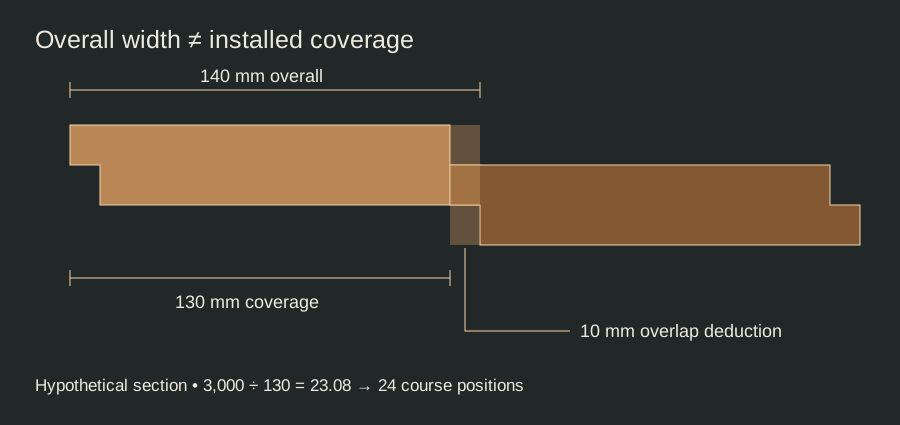
Overall width
The complete cross-section width.
Engagement / overlap
The portion that does not add new coverage.
Effective coverage
Overall width minus the documented deduction.
Hypothetical example: 140 mm overall minus a 10 mm coverage deduction gives 130 mm. A 3,000 mm layout needs 24 course positions: 23 cover 2,990 mm, leaving 10 mm at the last position. Review the edge layout; this does not approve a 10 mm strip. Gaps and cutting waste are excluded.
Download diagram (SVG)Original educational diagram · Hardwood Profiles · September 14, 2026.
Read the coverage example
The dimensions above are hypothetical. They show the difference between a complete section and the width each repeated course contributes; they are not dimensions for an available product.
Follow the remainder, not just the rounded count
For this example, 140 mm overall width minus the stated 10 mm deduction gives 130 mm of effective coverage. Across a 3,000 mm clear layout dimension, 23 courses cover 2,990 mm. A twenty-fourth position is needed for the remaining 10 mm. Twenty-four complete modules would cover 3,120 mm, which exceeds the example dimension by 120 mm.
That does not mean you should machine and install a 10 mm strip. A narrow final course may lose the interface or attachment needed by the chosen profile. Review the starting position, perimeter detail and actual profile before releasing a layout. Centering or changing the border can alter the end conditions, but those choices still need a workable section and attachment detail.
Use one documented coverage basis
If the supplier already gives an effective installed coverage, use it directly. Do not subtract the tongue or lap a second time. If only overall width is supplied, establish the actual engagement or overlap rather than guessing from a profile-family name.
A separate installed gap, reveal or perimeter allowance changes the model. Determine whether the documented coverage already includes it. Do not add a visual shadow line as an extra gap without checking the profile instructions. This example excludes those allowances so its arithmetic can be followed independently.
Measure across the courses
The 3,000 mm dimension runs across the repeated board widths. It is not the length of each board. A course count does not determine the stock lengths, end joints or cutting waste along those courses. Keep those quantities separate in the project record.
What to retain with the drawing
- Overall section width and its source.
- Effective coverage, stating whether a reveal is included.
- The clear dimension being filled and its direction.
- First- and last-course details, including any proposed rip.
- The profile revision used for the calculation.
Explore the section relationships in the profile explorer. A visual study does not verify supplied milling or approve a narrow edge course.